.svg)

Household businesses are one of the most common business models in Vietnam, widely adopted by individuals, families, and small and medium-sized sellers. During operations, the Certificate of Household Business Registration is an important legal document associated with the establishment and administration of the household business.
On July 24, 2026, the Ministry of Finance issued Decision No. 1995/QD-BTC, announcing seven amended and supplemented administrative procedures relating to the establishment and operation of household businesses, effective from July 27, 2026. This article examines the registration requirements, required documents, online submission procedures, and registration fee payment rules under the new regulations, as well as the accounting and tax obligations that arise once the Certificate has been issued.
1. Which Procedures Are Amended by Decision No. 1995/QD-BTC
Decision No. 1995/QD-BTC was issued on July 24, 2026, and took effect on July 27, 2026, while also repealing Decision No. 2352/QD-BTC dated July 3, 2025, issued by the Minister of Finance. According to the Ministry of Finance's announcement, the seven amended and supplemented administrative procedures, applied consistently nationwide, include:
-
Registration for establishment of a household business
-
Registration of changes to household business registration information
-
Registration for temporary suspension of business and resumption of business before the registered suspension period ends
-
Re-issuance of the Certificate of Household Business Registration and conversion to a Certificate of Household Business Registration
-
Termination of household business operations
-
Registration for updating or supplementing information in the registration dossier and correction of registration information
-
Suspension of business registration procedures
2. Household Business Registration Requirements for Obtaining the Certificate
A household business may be issued a Certificate of Household Business Registration when it satisfies all four registration requirements below. These are the key requirements that business owners should review before submitting their applications to minimize the risk of having to amend or supplement their dossiers.
2.1. Business lines must not fall under prohibited investment or business activities
A household business may only register business lines that are not prohibited by law. For conditional business lines, obtaining a Certificate of Household Business Registration does not mean that the household business can immediately commence operations. The business owner may only operate after satisfying all applicable sector-specific conditions and obtaining any required licenses or approvals.
2.2. The household business name must comply with the regulations
Under Article 86 of Decree No. 168/2025/ND-CP, the household business name must be written in Vietnamese and may include numbers and symbols. It must consist of two elements: the phrase “household business” and the business's proper name.
The household business name must not be identical or confusingly similar to the name of another household business registered within the same commune-level administrative area. Checking the proposed name on the National Business Registration Portal can help minimize the risk of having to change the name during the registration process.
2.3. A valid household business registration dossier
The household business registration dossier must contain all required documents, including the application for household business registration in the prescribed form, a copy of the valid legal identification document of the household business owner, and other relevant documents depending on the specific circumstances. If the household business is jointly established by household members, the dossier must include a written authorization appointing one member as the household business owner, in accordance with the regulations.
2.4. Payment of the prescribed registration fee
The registration fee is part of the registration procedure and must be paid in accordance with applicable regulations. The fee is not uniform nationwide but is determined by the People's Council of each province. Therefore, the business owner should check the applicable fee in the locality where the household business is registered before submitting the application. For online payments, the registration fee does not include any additional costs arising from electronic payment services, if applicable.
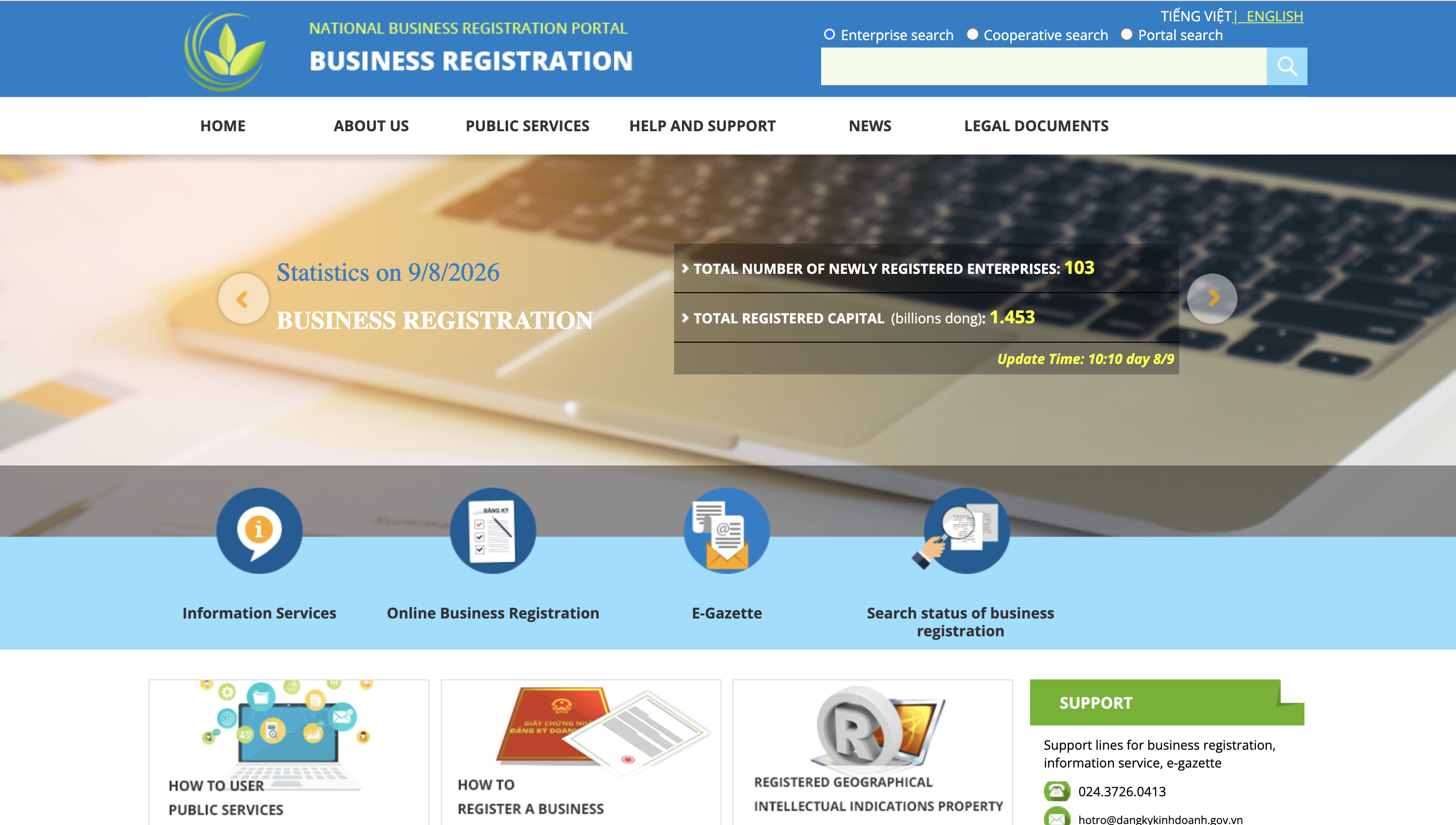
3. Online Household Business Registration Procedures
Online household business registration allows business owners to complete the procedure without directly submitting a paper dossier. However, electronic dossiers must meet requirements regarding their contents, format, declared information, and supporting documents under the applicable regulations. Failure to properly prepare the dossier may result in a request for amendments or supplements before the application can be processed.
3.1. Content and format of electronic dossiers
Electronic dossiers must contain all documents and declared information corresponding to those required in a paper registration dossier. Electronic documents should be named according to the corresponding document type in the dossier to facilitate review, receipt, and processing. Therefore, business owners should standardize the names of individual files according to the relevant document type rather than using file names that do not clearly indicate their contents.
3.2. Accuracy of declared information
Registration information must be fully and accurately declared on the household business registration information system and must be consistent with the electronic documents submitted with the application. Before submission, business owners should carefully review key information such as their full name, legal identification documents, address, business lines, and contact details to minimize the risk of amendments or supplements being requested due to discrepancies.
3.3. Mandatory contact information of the applicant
The applicant must provide a phone number and email address on the National Business Registration Portal as required by the procedure. These details are necessary for the business registration authority to contact the applicant and send relevant notifications during the processing of the application. Business owners should therefore use an active phone number and email address and regularly check for notifications after submitting the application.
3.4. Cases involving an authorized representative
If the procedure is carried out through an authorized representative, the electronic dossier must include the relevant documents evidencing the authorization in accordance with Article 93 of Decree No. 168/2025/ND-CP, in the form of valid electronic documents or electronic data. Authorization only changes the person directly carrying out the procedure; the dossier must still satisfy all requirements regarding its contents and required documents.
4. Three Methods of Paying the Registration Fee and the Non-Refund Principle
The registration fee must be paid at the time the application is submitted, rather than after the result is issued. Business owners may choose one of the following three payment methods:
| Method | Where to pay | Notes |
| Direct payment | The household business registration application receiving office at the commune level | Keep the payment receipt for reference when receiving the result |
| Bank transfer | The account of the commune-level business registration authority | Enter the correct transfer description as instructed by the receiving authority |
| Online payment | The National Public Service Portal | Electronic payment service fees are not included in the registration fee |
One point business owners should pay particular attention to is that the household business registration fee is not refundable if the household business is not issued a Certificate of Household Business Registration. Therefore, carefully reviewing the registration requirements, declared information, and required documents before submission can help minimize both processing time and unnecessary costs. For online payments, business owners can follow the instructions provided on the National Public Service Portal.
5. Standardizing Accounting and Tax from the Start
Once operations begin, household businesses must fulfill their tax, invoicing, documentation, and accounting record-keeping obligations in accordance with the regulations applicable to each business model.
For household businesses selling on e-commerce platforms, careful management of revenue data is particularly important. Platform revenue may consist of multiple components that need to be separated, including sales revenue, platform fees, adjustments, withheld taxes, and actual amounts received. Reconciling platform data with supporting documents and accounting records helps household businesses accurately determine revenue, tax obligations, and actual cash flow.
Sliner's accounting automation service supports the consolidation, standardization, and reconciliation of sales data, helping minimize discrepancies between data from different platforms and accounting records. In addition, Sliner works with household businesses to review tax obligations and plan their tax strategy, while keeping them up to date with tax policy changes in Vietnam and globally.