.svg)

1. What Is a Cash Flow Statement? Why Is It Important for eCommerce Businesses?
Cash Flow is a financial report that shows all the actual cash a business receives and spends within a specific period of time. Simply put, it helps businesses track where money is coming from, what activities the money is being spent on, and how much cash is actually available to maintain daily operations.
When a business sells products and receives payments from customers or eCommerce marketplaces, that is considered cash inflow. On the other hand, payments to suppliers, advertising expenses, shipping costs, warehouse operations, employee salaries, and other operational expenses are considered cash outflow. A business is considered financially healthy when the amount of incoming cash is sufficient to sustain and fund its daily operations.
Unlike accounting profit, cash flow only records actual cash transactions that have occurred. Items such as Accounts Receivable or Accounts Payable are not included in cash flow until the money is actually received or paid. These items are typically reflected in the Balance Sheet rather than the Cash Flow Statement.
This is also why many businesses can appear profitable while still struggling with cash shortages.
For example, at the end of the year, a business reviews its financial statements and sees a positive net profit of approximately $150 million VND. However, when checking the company’s bank account, the actual cash balance is only around $8 million VND. This raises an important question: if the business is profitable, why is there almost no cash left?
This is often the moment when business owners realize a fundamental financial principle: profit and cash flow are not the same thing.
A company can report profits on its Profit & Loss Statement (P&L) while still lacking enough cash to maintain daily operations. The reason is that profit reflects accounting results based on when revenue and expenses are recognized, whereas cash flow reflects the actual money entering and leaving the business. And that is exactly the role of the Cash Flow Statement (CF).
If the Profit & Loss Statement answers the question “Is the business making a profit or a loss?”, and the Balance Sheet shows “What does the business own and what obligations does it have?”, then the Cash Flow Statement answers the most operational question of all:
“Where is the money actually coming from, and where is it going?”
This is especially important in the eCommerce industry, where businesses constantly rotate capital across inventory, advertising, logistics, and multi-platform operations. Many eCommerce businesses appear to be growing rapidly on the surface, with increasing sales and revenue, while behind the scenes they are experiencing growing cash flow pressure because money is tied up in inventory, receivables, or expansion-related expenses.
For eCommerce businesses, cash flow is not simply another financial metric. It directly impacts operational stability, growth capability, and the long-term sustainability of the entire business model.
2. What Does a Cash Flow Statement Reveal Behind Profit?
Once businesses begin analyzing their Cash Flow Statement, they often gain a much clearer understanding of what is happening behind seemingly positive profit figures.
Although the company recorded a profit of 150 million VND, most of that money had not actually returned to the bank account. A large portion of cash was tied up in inventory, which increased by 180 million VND, while receivables from eCommerce platforms increased by another 50 million VND. This means the business successfully generated sales and recorded revenue in its accounting reports, but the actual cash had not yet been fully collected.
Meanwhile, to maintain operations, the company had to continue borrowing from banks and injecting additional owner capital. At the same time, a significant amount of cash was spent on delivery trucks and operational equipment investments. As a result, despite reporting healthy accounting profits, the ending cash balance barely increased.
This highlights the biggest difference between profit and cash flow.
If the Profit & Loss Statement acts as a “performance report card” showing how efficiently the business operates, and the Balance Sheet serves as a “financial snapshot” at a specific point in time, then the Cash Flow Statement functions as a tracking system for the movement of cash throughout the entire business operation.
The report helps businesses understand where cash is truly coming from, how it is being used, and whether the business is generating enough cash internally to sustain growth.
Unlike profit, which can be influenced by accounting timing and revenue recognition, cash flow reflects the actual movement of money in and out of the business. This is why the Cash Flow Statement is often considered one of the clearest indicators of a company’s real operational financial health.
3. What Does a Cash Flow Statement Include?
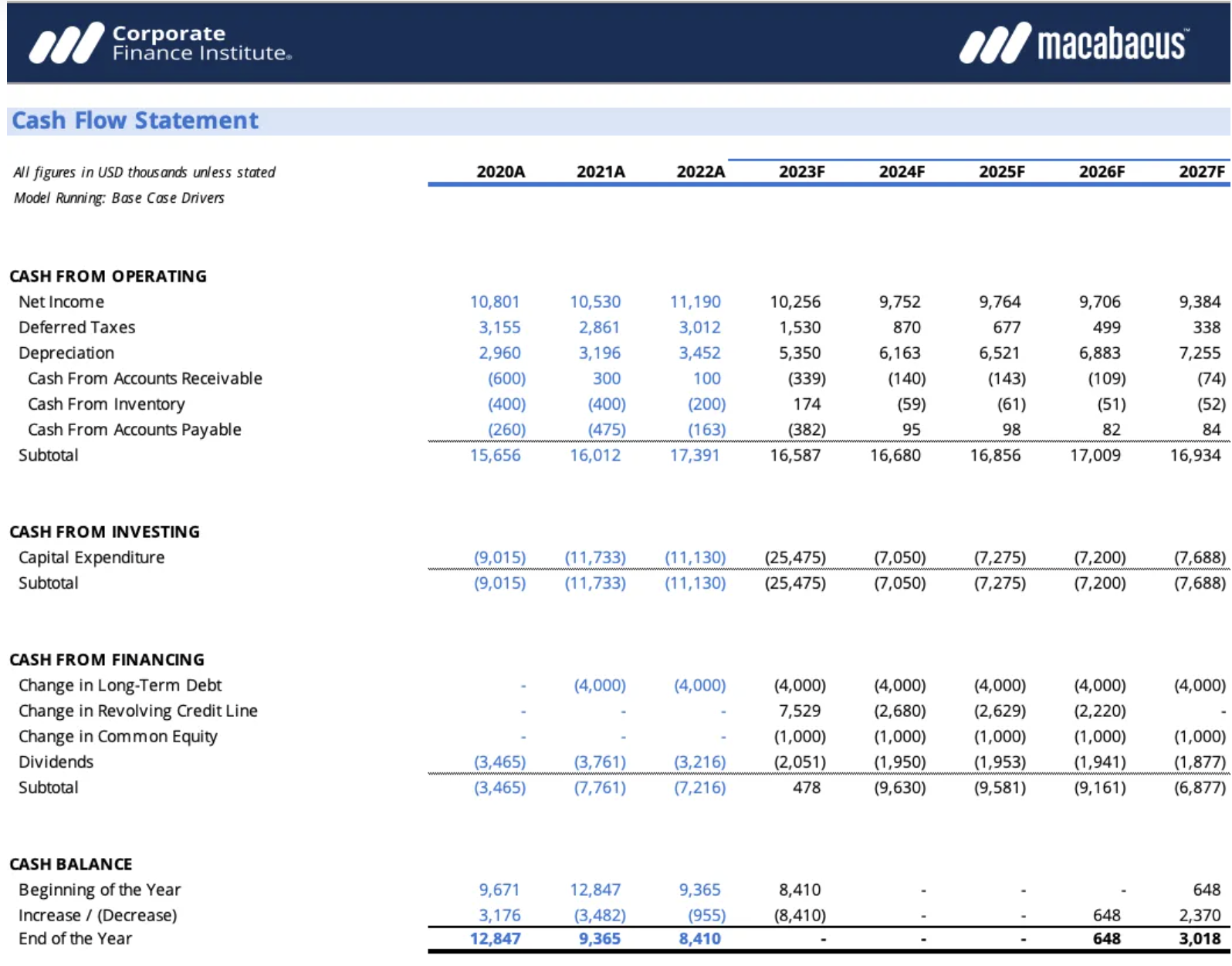
To better understand a company’s financial condition, the Cash Flow Statement is generally divided into three main sections: Operating Cash Flow, Investing Cash Flow, and Financing Cash Flow. These three sections work together to reflect the complete “journey” of cash within a business — from how cash is generated, where it is spent, and how the business maintains funding for operations and growth.
3.1 Operating Cash Flow
Among the three categories, Operating Cash Flow is usually considered the most important because it reflects the company’s ability to generate cash from its core business activities.
This includes cash generated from daily operations such as product sales, marketplace payments, supplier payments, advertising expenses, employee salaries, warehouse operations, and logistics.
For eCommerce businesses, this section clearly indicates whether the current business model is truly generating cash. A company may grow revenue rapidly, but if operating cash flow remains consistently negative, it suggests that the business has not yet established sustainable cash generation from operations.
In reality, many eCommerce businesses experience strong revenue growth while facing worsening cash shortages. This often happens because businesses must purchase inventory upfront to avoid stockouts, spend heavily on advertising to maintain ranking and market share, while marketplace payouts may take days or weeks to arrive. As a result, cash becomes tied up in inventory and receivables instead of returning to the bank account for operational use.
Two Methods of Presenting Cash Flow from Operating Activities
Cash flow from operating activities can be presented using two different approaches: the Direct Method and the Indirect Method. While both methods aim to show how much cash is generated from business operations, they differ in the way cash flow information is presented.
Direct Method
The Direct Method clearly presents the actual cash inflows and cash outflows generated during the reporting period. This approach allows businesses to directly track how cash moves through daily operations.
Common items presented under the Direct Method include:
-
Cash received from customers
-
Payments made to suppliers
-
Salaries and employee-related expenses
-
Operating expenses paid in cash
-
Interest and taxes paid
The main advantage of this method is its transparency and ability to provide a clearer view of real cash movements, helping businesses better monitor liquidity and short-term cash flow management.
Indirect Method
The Indirect Method starts with accounting profit before tax and then adjusts non-cash items and working capital changes to determine the actual cash generated from operating activities.
Common adjustments under the Indirect Method include:
-
Depreciation and amortization
-
Changes in accounts receivable and accounts payable
-
Inventory fluctuations
-
Provisions and accruals
-
Non-cash expenses or unrealized revenue
-
Interest and taxes paid
This is the more commonly used method in financial reporting because it helps businesses connect accounting profit with actual cash flow, making it easier to understand why a company may appear profitable but still experience cash shortages.
Regardless of which method is used, the ultimate purpose of the Cash Flow Statement is to help businesses monitor cash generation, manage liquidity, and evaluate the overall financial health of the business.
3.2 Investing in Cash Flow
Investing in Cash Flow reflects the money used for long-term investments or assets that support future business growth.
For eCommerce businesses, this may include expanding warehouse facilities, purchasing livestream equipment, building product photography studios, implementing ERP systems, or acquiring operational machinery and equipment.
Unlike operating cash flow, negative investing cash flow is not necessarily a bad sign. In many cases, it indicates that the business is investing in future expansion and long-term growth.
However, if a company invests too aggressively while operating cash flow remains unstable, cash shortages can quickly become a serious issue. This is one reason why many fast-growing businesses still struggle with operational liquidity.
3.3 Financing Cash Flow
Finally, Financing Cash Flow reflects cash movements related to how the business raises and manages capital.
This includes bank loans, investor funding, owner capital contributions, debt repayments, and dividend payments.
In the early stages, many eCommerce businesses survive primarily through financing cash flow rather than cash generated from operations. This is not necessarily wrong, especially for startups or rapidly scaling businesses.
However, if a business depends too heavily on loans or investor capital for too long, financial risks increase significantly because the company has not yet developed stable cash generation from operations.
4. How to Monitor Cash Flow Statements to Optimize Operations and Growth
In eCommerce, cash flow management is not just an accounting task: it directly impacts a company’s growth strategy. A business may achieve rapid revenue growth but still face serious cash flow issues if it expands too aggressively without controlling its capital cycle.
For example, when a business increases its advertising budget to scale sales, higher order volume also leads to larger inventory purchases, higher fulfillment costs, and greater inventory pressure. Meanwhile, payouts from marketplaces such as Amazon, Shopee, or TikTok Shop may take days or even weeks to arrive. This payment delay creates constant pressure on working capital, even when revenue reports appear very positive.
This is a common challenge for cross-border eCommerce businesses. Many Amazon sellers in the US, for instance, invest heavily in PPC advertising and inventory before major shopping events like Prime Day or Black Friday. However, marketplace payouts are often released on a scheduled cycle, causing some businesses to become “profitable but out of cash”, showing profits on paper while lacking enough cash to sustain daily operations.
Similarly, many DTC (Direct-to-Consumer) brands expanding into multiple international markets face increasing pressure from global logistics and inventory management. Restocking cycles can take weeks or even months, meaning cash remains tied up in inventory for long periods. This becomes even more challenging when businesses must pay suppliers upfront while receiving delayed payments from marketplaces or international payment providers.
That is why monitoring the Cash Flow Statement is essential for understanding whether a company’s current growth is truly sustainable. A healthy business does not only grow revenue, it also generates enough cash flow to continuously support its own operations.
For cross-border eCommerce businesses, cash flow management becomes even more complex due to international logistics costs, long restocking cycles, marketplace fund holds, and foreign exchange risks. As businesses scale across multiple markets simultaneously, even a small disruption in cash flow can impact the entire operational chain.
5. How Sliner Supports eCommerce Businesses in Cash Flow Management
In eCommerce, businesses often need to manage multiple expenses at the same time, including inventory, advertising, logistics, and multi-platform operations. As businesses scale, cash flow management becomes more complex, making it difficult for many companies to accurately track where money is coming from and where it is being spent. As a result, some businesses may continue growing in revenue while still facing cash flow pressure or financial management challenges.
Sliner helps eCommerce businesses standardize their financial and cash flow management systems by consolidating data from multiple platforms into one unified system. This allows businesses to gain clearer visibility into cash flow, operational expenses, liabilities, and overall financial performance.
Beyond financial tracking, Sliner also supports businesses in optimizing their financial operations and building a complete financial reporting system. With an experienced accounting and finance team specialized in eCommerce, Sliner helps businesses improve financial processes, strengthen cash flow control, and make more sustainable long-term growth decisions.

![[WORKSHOP RECAP] Sliner x OnPoint Empower Vietnamese Brands Entering TikTok Shop US](https://cms.sliner.sg/storage/uploads/blogs/94EgfLvLg1ViK3MHSzKVi0WI18kUL3EgIVK9OVh8.jpg)